Tuesday, 8 September 2015

Reclaiming Catholic Social Teaching: post 8


Week 3: chapters 6-8.

We turn to chapter 7, 'Work'.

(If you've just joined us, have a look at this post for orientation...)

Key point:


  • Work should be a fully human relationship where employer and employee are bound by friendship rather than simply power and money.


My synopsis:

Modern work dehumanises us. It encourages us to luxury and to use others simply as resources. On the other hand, work allows us to be fully human in serving and being served by our fellow man. As in all things, to ignore God in work is to cut away the foundation of our humanity.

My critical discussion:

Again, Esolen starts the chapter with a picture, Murillo's painting of the Holy Family (above), The space is full of 'business', but it is a business conducted in the sight and awareness of God, and between people who have a genuine affection and relationship with each other.

Esolen in this chapter turns to paradigmatic aspects of Catholic social teaching as it is known in the modern world: Leo's Rerum Novarum and the nature of work and the State. The very fact that it is only now, right near the end of the book, that these things emerge, is a sign that Esolen regards much of the presentation of Catholic social teaching as flawed. Rerum Novarum is not itself a new thing, but simply an application of existing Catholic principles. Wealth, poverty and work are not things which can be treated in isolation from our wider human nature, but have to be understood against an understanding of our natural and supernatural ends. The family, as the first society for human beings, helps us understand what it is to have a fully human relationship with others. Great art and the Western tradition of thought help us understand and apply abstract principles in concrete ways.

Leo's Encyclical, Rerum Novarum, makes much of the Guild: that body of workers who come together in self managing 'unions' and who establish a culture of mutual respect between master and worker. In essence, they are a way of bridging the gap between the affection of a family and the public, utilitarian space of work. The nearest equivalent in modern times is the profession (eg that of law). But even these are succumbing to the pressures of the market and being replaced by a more impersonal, temporary set of relationships between competitors.

Questions:

  • What are the features of a successful working life?
  • Is it possible to be idle throughout one's entire life and be happy?
  • Is there a way of reconciling the innovation and cost reduction brought about by a competitive market with a 'family like' atmosphere in a workplace? 
  • Is anything like a 'family' atmosphere in a workplace really desirable? Doesn't it lead to an absorption of private life by the employer?


[Details of image: Murillo, Holy Family with Little Bird. Full details here.]


[Back tomorrow (9/9/15) with the final post this week on chapter 8, 'The State'.]

Monday, 7 September 2015

Reclaiming Catholic Social Teaching: post 7


Week 3: chapters 6-8


For new readers:

We are now at the beginning of the third week of this four week course. The first post of the course was here.

If you have been following the posts up till now, well done and I'll say more about this week's work below! For anyone who has just arrived on the blog, welcome! There's absolutely no reason why you shouldn't join in now. In essence, this course is just me blogging through Anthony Esolen's book. The posts therefore can be read at any time as prompts to further thought about this work: there is absolutely no reason why this has to be restricted to the period of the four weeks ended 21 September 2015. However, if you are reading this during the four week period, I have left the final week (beginning on 14 September 2015) relatively free of reading the book (we'll only be looking at one chapter in that week) with a few to encouraging some critical reflection on the book as a whole, As it is a relatively short book, there is plenty of time to get the book, read it, and contribute to the comments box in the remaining period of the course. (A Kindle version of the book is available here.)

My synopsis of the course up till now:

In the first five chapters of the book, Esolen has concentrated (following Leo XIII) on the key structures of human societies rather than the neuralgic issues which are often taken to be the heart of Catholic social teaching. He methodology is to to a) restrict himself to Leo XIII writings; b) to integrate this social teaching with the entirety of Catholic teaching rather than to view the social teaching as something separate from (say) teaching on sexual morality or the nature of God; c) to view the teaching through a sensibility enriched with the classical tradition of Western art, thought and philosophy.

In previous chapters, Esolen has focused on the family and the associations of 'civil society': those associations which exist in the space between the State and the family. He does this to reflect a key feature of Leo's teaching: that human nature's fulfilment in associating with other human beings is not done primarily through the State. Moreover, the State exists to reinforce those naturally existing associations rather than to create them from scratch. (Modern reworkings of family life to include divorce and same sex marriage are clearly in Esolen's (and Leo's) sights here.)

My synopsis of chapter 6: The Church as Society:

Key point:

  • The Church is not so much just one other society that human beings may or may not belong to, but the perfect society which is a model for all others.

Modern understandings of social life tend to privilege the political State as a model. Among early modern thinkers such as Hobbes and Locke, the social contract suggests a democratic basis for authority: atomistic indviduals come together in a social contract to form a society -the State. Instead, taking the Church as the paradigm of Society, the model of good human relationships becomes (eg) one which rests on God-given authority (and not the consent of individuals) and one focused on our relationship with God (rather than, as in Hobbes, our physical safety). Democracy can be a valuable part of human life, but, for Leo and Esolen, 'the Church [is] the standard by which we judge democracy' (p.131) rather than vice versa.


My critical discussion of the chapter:

Esolen's book is undoubtedly counter cultural, at least in the sense that it champions some unfashionable social positions. We've already looked in previous chapters at the value of liberty which Esolen has critiqued in its modern form as mere licence and whim. He is now critiquing the value of democracy which again tends to be one of the assumed pillars of modernity: good government is, at the least, democratic. 

If democracy is one of the principles of a good society, the Catholic Church is going to be found wanting! (And indeed, Esolen makes the point that it is precisely in this area that much modern criticism of the Church is focused.) If on the other hand, there are more important principles of society than democracy (and in fact, if democracy is only justifiable to the extent that it serves those more ultimate principles) then it becomes more plausible to argue that the Church is the standard by which other societies are judged than vice versa.

This is probably going to be one of the key areas for assessing your reaction to Esolen and Leo. If you think that democracy is a simple, obvious good, then you are going to find it hard to accept a view of social teaching which stresses the value of hierarchy and authority over democracy. On the other hand, Esolen is certainly not rejecting democracy as a good in its place. To claim that the Church is a model of human association is not to suggest that its structures are simply reproducible in other areas (such as that of the State or even the family). Whatever we may learn from the Church as a model of how to relate to other human beings cannot simply be reproduced mechanically in our family or political life: Church and State are not identical. 

As usual, Esolen refers constantly to Leo XIII's writings. Perhaps the key one for this chapter is Testem Benevolentiae (on 'Americanism'): here.

Questions: (feel free to respond to these or any others in the comments box!):

  • Should all human societies (family, Church, State, businesses) be democratic? Why?
  • Given scandals such as child abuse, can the Church be considered as a model for human relationships?
  • What is the role of authority in human relationships? Is it 'God given'? (And what might that mean?)
[I'll post tomorrow (8/09/15) on chapter 7!]


Wednesday, 2 September 2015

Reclaiming Catholic Social Teaching: post 6


"Americans of all ages, all stations of life, and all types of disposition are forever forming associations...In democratic countries knowledge of how to combine is the mother of all other forms of knowledge; on its progress depends that of all the others." Tocqueville: Democracy in America here

We continue week 2's sessions with the final chapter in this section: 'Social life'.

Key points:

  • Small associations are a key element in the flourishing human life.
  • The existence of such associations, both in the Church and in wider society has been under attack in the modern West.


My summary:

Leo emphasises the importance of what is often described as 'civil society': that type of association or society which is intermediate between the State and the family. In particular in this chapter, Esolen emphasises those associations ('pious societies' such as the Legion of Mary (p. 97) which both focus on the supernatural end of human beings but also on their natural end through friendship and mutual support. It is these associations which have often withered away in modernity, either as a result of deliberate targeting or by social changes.

My critical discussion:

Esolen starts the chapter with a discussion of Tocqueville's identification of small associations as a noticeable strength of nineteenth century US life:

"Americans of all ages, all stations of life, and all types of disposition are forever forming associations...In democratic countries knowledge of how to combine is the mother of all other forms of knowledge; on its progress depends that of all the others." Tocqueville: Democracy in America here

It is certainly true that much Catholic social teaching focuses on this level of social engagement: together with an emphasis on the family, this emphasis on the 'little platoons' ( a phrase from Edmund Burke) is in stark opposition to either individualism or an emphasis on the State. (As such, many of its themes have been taken up in Phillip Blond's Red Toryism or Maurice Glasman's Blue Labour. ) These societies have a natural right to exist which is not delegated to them by the State or even simply by the individual: they are more the basis for individuality and the State rather than the effects of them.

There is, once again, a methodological point to be made here about Esolen: by starting the chapter with a discussion of Tocqueville, he locates Catholic social teaching in history, in particular in the tradition of Western political philosophy and of the canon of Great Books.

Although Esolen, as usual, refers to a number of Leo XIII's documents in this chapter, perhaps the most relevant to read is Quod Apostolici Muneris. 

Questions:

  • Changes in the family and in the 'little platoons' of civil society are particularly noticeable in modern societies. Should we see these changes as attacks on their existence or simply as changes, either neutral or even benign?
  • Life in Catholic parishes is, according to Esolen, no longer dominated by these 'muscles' of Catholic life (p.97). Is that true? Is it regrettable?
[This is the final post for week 2. Join me on 7 September for the posts on week 3, starting with chapter 6: The Church as Society.]

Tuesday, 1 September 2015

Reclaiming Catholic Social Teaching: post 5


                                                                    Sigrid Undset


Week 2: 

We continue week 2 of the course on Anthony Esolen's Reclaiming Catholic Social Teaching by looking at chapter 4 on 'The Family'.

My synopsis:

  • The family is the fundamental society: it is both a society itself and the foundation for other societies such as the State.
  • The family is the space within which individuals are formed who have an understanding of their natural end and, fundamentally, of their supernatural end as oriented towards God.
My critical discussion:

Esolen starts this chapter again with a discussion of a work of art: the novels of Sigrid Undset and, in particular, her triology, Kristin Lavransdatter. (I've made this point before, but it's worth stressing again Esolen's methodology here. He constantly refers to art and particularly canonical works of the Western tradition: for him, the idea of Catholic social teaching appeals to a prudentia -the virtue of practical wisdom formed in part by the Western classical tradition.) Undset's novel focuses on a household, indeed, a patriarchal household of the Scandinavian Middle Ages. By seeing the concrete nature of such a society and its goodness, Esolen (and Undset) hope to restore the vision of a natural pattern of human existence as good, in opposition to the theoretical modern opposition to patriarchy and the family. (Esolen doesn't make this point, but Undset herself lived through a divorce, war and the death of her oldest child. If she has a vision of the 'good family' it is not through a naive ignorance of its problems.) 

This chapter continues on from the previous one on marriage. In essence, it repeats and extends the message of the centrality of the family to human social life, its naturalness as a society (rather than its existence as a voluntary contract), and the existence of attacks on it by secularised modernity.

Questions:
 
  • Esolen constantly argues that the family helps the individual to see herself 'oriented beyond time, to God' by seeing an loving its origins (parents, grandparents) and its future (children, grandchildren). Does that mean that those of us who don't have the experience of knowing our parents (or having children) are harmed in some way?
  • Esolen (and Leo) emphasises the importance of the father's role in leading the family. Since this is obviously a 'patriarchal' thought. do we need to bother reading on?
  • If Catholicism is based on the traditional family, isn't that precisely why it's going to fail in future years?

Works of Leo referred to in chapter:

From now on, I won't be listing the references to Leo's works on the individual blogposts. The full set of documents referred to by Esolen are listed here. Perhaps the two most important writings for this chapter are Arcanum divinae (Vat. Eng. version here), and Rerum Novarum [Vat. Eng. version here.] The latter in particular is often seen as the foundation stone of Catholic social teaching. It would be an interesting exercise to read the document focusing instead on some of the more countercultural sections on the nature of the family. (Eg: sections 13 and 14.)

[Next post -the final one of  week 2- will be tomorrow 1 September 2015.]

Monday, 31 August 2015

Reclaiming Catholic Social Teaching: post 4


Welcome to the second week of our course of reading through Anthony Esolen's Reclaiming Catholic Social Teaching.

Where we have got to:

Liberty without an understanding of the goals of that liberty is destructive both of the individual and society. To understand those goals requires both an understanding of the Church's teaching and the tradition of classical western philosophy within which it is situated. We are approaching that understanding through a review of Leo XIII's writings. As Esolen ends ch2 (pp48-9):

And it is Christ, not democracy, much less the mechanics of elections, who has set us free. Free for what purpose? To attain our human and superhuman ends; and, by our very nature, we are meant to do that within a society. What, then, is a society? Let us now turn, as Leo does, to the first natural society of mankind: the marriage of man and woman.

Week 2 (31 August 2015-6 September 2015):

During this week, we will be reading through chapters 3- 5 of the book. That's approximately 60 pages and I reckon (again on average reading speeds) should take just about an hour to get through.

Chapter 3: Marriage

Key points:

  • Marriage and the household is the key to much of Catholic social teaching
  • Marriage is the 'prime society' (p.54) and the basis for the State, not the other way round.
 
My synopsis of chapter:

'Economics' etymologically is the law of the household (Greek: oikia). It is the understanding of the household as the centre of human life that informs Leo XIII's teachings and why Esolen approaches wider questions of (the modern understanding of) 'economics' through the household.

Within marriage, human beings serve their supernatural ends (the family is 'the reflection of the inner life of God' (p.53) and their natural ends (the procreation and education of children; the virtuous disciplining of their desires). The assault on marriage through, for example, divorce is not of marginal importance to Catholic social teaching: it instead strikes at its heart.


Esolen refers to the Norman Rockwell painting from his series the Four Seasons (above): 

We know, without being told, that this scene is right. The boy and the girl are for one another. They are alone in all four pictures, but they are not alone. They are part of the good and lovely world of trees and snow and weedy flowers and dogs...But in their seedling love, they too form a society, a world. 

(pp.73-4)

My critical discussion of chapter:

One characteristic of Esolen's book is that it doesn't fulfil the usual pattern of many works on Catholic social teaching. Instead of concentrating on (say) work and poverty, if there is a core of the book, it is in these central sections on the household. Bearing in mind what I have said in earlier posts about Esolen's desire to integrate Catholic social teaching into the whole of Catholic doctrine (see, eg, my first post here), this emphasis on the household is a key element in integrating what some regard as a 'traditional' obsession with sexual morality with a 'modern' emphasis on social justice. Esolen, following Leo XIII, sees the two as inseparable.

Perhaps the key issue here is the question of the individual. If (as in much liberal thinking) you see human beings as separate persons coming together voluntarily to form larger collectives, then the 'family' is simply one of those voluntary associations, formed by consent, and open to redesign of the wills of those individuals concerned change. (The decline of the 'traditional family' is thus of no more importance than the decline (say) of the 'sewing circle': modern individuals have simply come up with different and better ways of associating to fulfil their needs and desires.) On the other hand, bearing in mind what Esolen has said about 'liberty' in chapter 2, from Leo XIII's viewpoint, marriage and the family is the context within which liberty is exercised: it is the natural structure within which we are free to act, rather than a structure we are free to redesign.

Turning to Esolen's use of Rockwell, I confess I find these images almost nauseating. Esolen does acknowledge the limitations of his art and I'm afraid, for me, these are very difficult to overcome. But Esolen does, I think, have a point worth pondering. What is it about these images that is right? What is the potency of seeing children on the verge of something greater than themselves? (And I would add, what is the precise failing of Rockwell here? What might that tell us about the weakness of the non-Catholic traditional vision of marriage that made it so vulnerable to modernity?)

The key text of Leo XIII's on marriage is Arcanum dei. It is worth reading in full.


Questions: (feel free to discuss these and any others in the comment box)

  • How convincing do you find the claim that marriage and the family is the centre of our social nature?
  • Does that marriage have to have a particular shape? Why couldn't we (as advocated by Peter Tatchell among others) replace marriage with a form of association to reflect the variety of possible desires? 
  • Clearly many people don't find Esolen or Leo XIII's vision of marriage convincing. What does that show about the nature of disagreement on this sort of issue? Are there arguments which might make this vision convincing?
  • What is right and wrong with Rockwell's images in the Four Seasons pictures above?

[I'll post on chapter 4, The Family, tomorrow (1 September 2015).]


Wednesday, 26 August 2015

Reclaiming Catholic Social Teaching: Post 3


[Details of image: here]

For previous post, see here.

Chapter 2: Human Liberty

We complete the first week's work by looking at the chapter on liberty.

Key points:

  • Liberty without order based on a true sense of what is fulfilling for human beings is self-destructive.
  • An obsession with replacing tradition involves the wilful destruction of the accumulated wisdom of humanity. 


My summary:

Esolen adduces three main arguments against an undue emphasis on liberty(ie liberalism) in this chapter. First, liberalism is an 'innovation' and such innovations, changes to the established wisdom of humankind, carry a heavy burden of proof before they should be accepted. Secondly, liberalism leads to tyranny. Thirdly, submission to divine law and authority provides protection against both the tyranny of individuals and of the State.

Democracy is not always and everywhere the best form of government: although it can allow an appropriate liberty, it can also set the conditions for excessive liberty and tyranny.


My critical commentary:

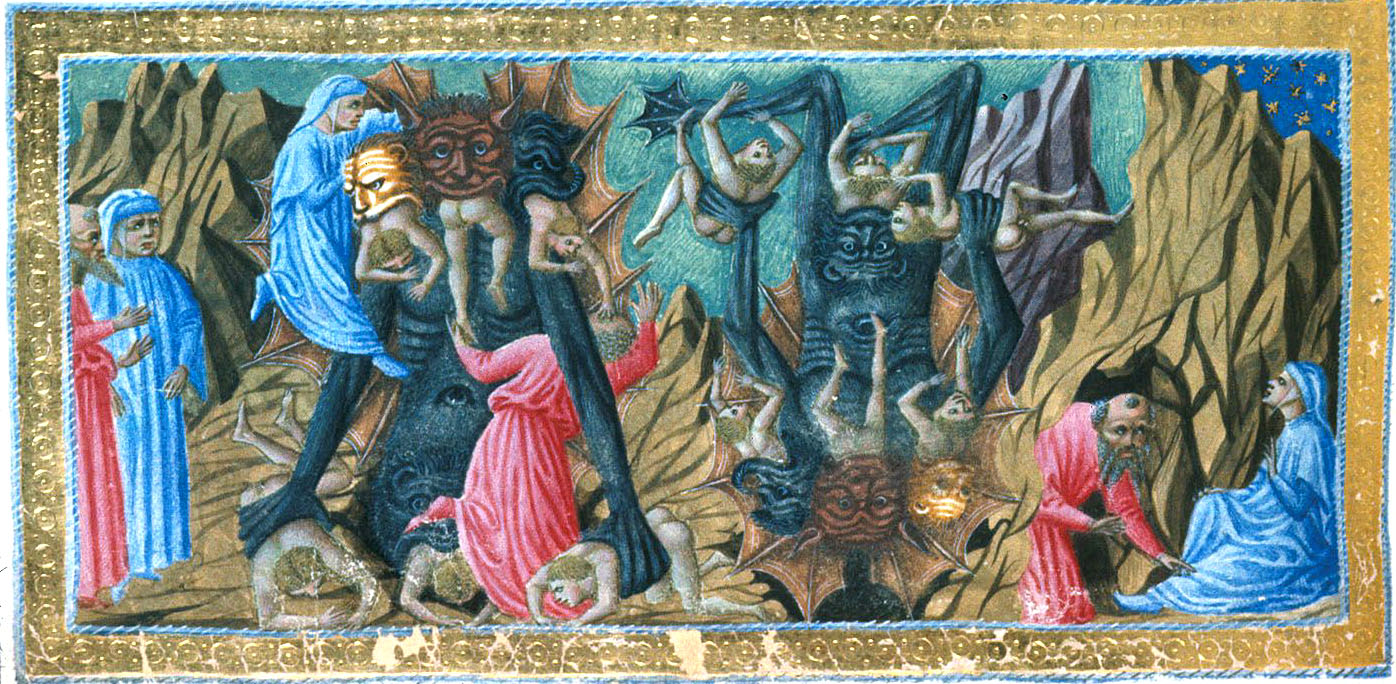
Esolen begins this chapter with the image of Satan from Dante's Inferno, trapped in ice, gnawing on three traitors. (This is from Inferno, Canto 34. The English text may be found here.) For Esolen, this is the image of modern, empty freedom: the licence to do everything become the emptiness of nothingness. (As an aside, it's worth thinking about Esolen's methodology here, in his constant reference to great works of art, visual and literary. Are these merely educational aids to make understanding of complex arguments easier? Or does art reveal something that the conceptual thinking of philosophy cannot? If a society has abandoned its great art, has it also abandoned a privileged access point to reality?)

An obvious objection here is that Satan (eg by being trapped in ice) is not at liberty at all. But the charge that liberty and democracy produces a sort of desperate and futile search for meaning and eventual tyranny is an old one. (The decline from democracy to tyranny is, for example, described by Plato in the Republic.)  The key thought here is that lack of an order based on human nature (and of the nature of the universe) leads to personal disorder (the triumph of tyrannical whims over reason) and social disorder (the triumph of a tyrant). 

Questions:

  • Isn't the promotion of maximum liberty the best form of government?
  • Given that we have no agreed idea of what a 'natural order' might be, isn't the best thing simply to allow people to do what they like?
  • We know that the past is shot through with patriarchy and other unfortunate tendencies. Doesn't this alone give as reason to prefer 'innovation'?

This is the end of the first week's work. Do feel free to keep commenting! The next post (week 2) will be on Monday 31 August.


--------------------------------------------------------------------------------
Works of Leo XIII referred to in chapter (in order of reference; page number in book cited):

Libertas praestantissimum here. (p.40) 

Praeclara grationis publicae here. (p.43)

Inscrutabili here. (p.43-4)

Quod Apostolici muneris  here. (p. 44)

Immortale Dei here. (p.44)

Humanum genus here. (p.44)

Rerum Novarum here. (p.44-5)

Inscrutabili here. (p.46)

Quod Apostolici muneris  here. (p. 46)

Immortale Dei here. (p.46)

Libertas praestantissimum here. (p.46)

Pervenuti all'anno (Italian version here.) (p.47) 

Immortale Dei here. (p.47)

Libertas praestantissimum here. (p.47)

Sapientiae Christianae here. (p.47)

Testem Benevolentiae here. (p. 48)


Tuesday, 25 August 2015

Reclaiming Catholic Social Teaching: Post 2


Previous post here.


Chapter I: Man, in the Image of God

We continue the first week's work of reading through the introduction and chapters I and II.

Key points:


  • A secular society which ignores God is a deeply flawed society because it misunderstands human beings and their nature.
  • Such a society becomes dominated by irrational and inconsistent desires.
  • Only in a Catholic society where unity is based on the unity of the Eucharist can human beings flourish fully.


My summary:

If we forget that human beings are made to enjoy God, any society based on such forgetfulness will be based on false principles and radically flawed. In particular, a society from which God has been banished will be subject to the 'domination of the passions' (p.26). Without Christianity -and in particular, without its source in the Eucharist- the bonds which link people to people in society will be lost.

My critical commentary:

 Esolen has in his sights here secularism. Although this is a term without any exact definition (and has been used in various ways in various contexts) one idea is that politics should be conducted without any religious content: that whatever we believe in private, as citizens we enter into a public space where public rationality excludes the introduction of views based on religious doctrine.

The problem with this is, as Esolen notes, if we believe that human beings are creatures whose happiness involves a relationship with God, any society that ignores such a relationship is not going to be well run. (It's rather as if, in constructing a society, we ignored the human need for food. It's just not going to turn out well...)

As well as this general point, Esolen argues for the specific importance of Catholicism. He takes The Angelus by Millet as an illustration of this.


[Image from Wikipedia. Details here.]

In essence, Esolen picks up from this painting a natural order (man/woman; labour/rest) in the context of the Church (the Angelus). Separate that natural order from Catholicism, and our understanding of it starts to fray.

What are we to make of this? Why should in principle truths be excluded from society simply because they are religious? (And what exactly is a religious truth as opposed to a common-or-garden one?) Certainly, if most people reject religion and especially Catholicism, then it's going to be difficult to persuade people in a democratic country to acknowledge beliefs restricted to those practices. But there are all sorts of truth that it might be difficult to persuade people of for all sorts of reasons...

On the other hand, isn't the truth of secularism that some things are quite obvious to all people (the human need for food and shelter) whilst some things are not (the human need for God)? Don't we have to compromise on what can be agreed, rather than what we might like to see agreed?

Esolen would undoubtedly reply here that, whatever the practical difficulties involved in convincing people of the truth about human beings, in the absence of such convictions, society will fare badly. Without at least the classical philosophical ideas of ordering our desires according to reason, society will be radically unstable as individuals pursue their whims.

Questions (please feel free to debate these or any others in the comments box below!):

  • Are you convinced by Esolen's vision of an ordered society? Why? Why not?
  • Philosophers such as Alasdair MacIntyre have argued that radical (and irresolvable) disagreement on values is part of the modern condition. If that is the case, are modern democratic states condemned to fail? 
  • Does Millet's The Angelus provide a helpful image of a society in good order?

I'll post on chapter 2 (the final one of this week) tomorrow (Wednesday)...


------------------------------------------------------------------------------------------

Writings of Leo XIII referred to in this chapter (in order of reference, page number in book given):

[No need to read these fully. Esolen usually provides extracts when discussing the texts. I have included these links to the full texts for those interested in pursuing further reading.]

Tametsi [1900] Here. (p15)

Rerum Novarum [1891] Here. (p.16)

Humanum Genus [1884] Here. (p.16)

Tametsi [1900] Here. (p17)

Aeterni Patris [1879] Here. (p.17)

Rerum Novarum [1891] Here. (p.18)

Au milieu des solicitudes [1892] Here. (pp. 21-3)

Humanum Genus [1884] Here. (p.23-6)

Affari Vos [1897] Here. (p.24)

Arcanum Divinae [1880] Here. (p.26)

Inscrutabili [1878] Here. (p.26)

Cum Multa Sint [1882] Here. (p.26)

Immortale Dei [1885] Here. (p.27)

Sapientiae Christianae [1890] Here. (p.27)

Tametsi [1900] Here. (p27)

Arcanum Divinae [1880] Here. (p.30)

Humanum Genus [1884] Here. (p.31)

Tametsi [1900] Here. (p.32)

Immortale Dei [1885] Here. (pp.32-33)

Mirae Caritatis [1902] Here. (pp. 33-34)

Pervenuti all' anno [1902] Italian version here. (p.34)

Libertas Praestantissimum [1888] Here (p.35)


[Image: Wikipedia details here.]