Monday, 31 August 2015

Reclaiming Catholic Social Teaching: post 4


Welcome to the second week of our course of reading through Anthony Esolen's Reclaiming Catholic Social Teaching.

Where we have got to:

Liberty without an understanding of the goals of that liberty is destructive both of the individual and society. To understand those goals requires both an understanding of the Church's teaching and the tradition of classical western philosophy within which it is situated. We are approaching that understanding through a review of Leo XIII's writings. As Esolen ends ch2 (pp48-9):

And it is Christ, not democracy, much less the mechanics of elections, who has set us free. Free for what purpose? To attain our human and superhuman ends; and, by our very nature, we are meant to do that within a society. What, then, is a society? Let us now turn, as Leo does, to the first natural society of mankind: the marriage of man and woman.

Week 2 (31 August 2015-6 September 2015):

During this week, we will be reading through chapters 3- 5 of the book. That's approximately 60 pages and I reckon (again on average reading speeds) should take just about an hour to get through.

Chapter 3: Marriage

Key points:

  • Marriage and the household is the key to much of Catholic social teaching
  • Marriage is the 'prime society' (p.54) and the basis for the State, not the other way round.
 
My synopsis of chapter:

'Economics' etymologically is the law of the household (Greek: oikia). It is the understanding of the household as the centre of human life that informs Leo XIII's teachings and why Esolen approaches wider questions of (the modern understanding of) 'economics' through the household.

Within marriage, human beings serve their supernatural ends (the family is 'the reflection of the inner life of God' (p.53) and their natural ends (the procreation and education of children; the virtuous disciplining of their desires). The assault on marriage through, for example, divorce is not of marginal importance to Catholic social teaching: it instead strikes at its heart.


Esolen refers to the Norman Rockwell painting from his series the Four Seasons (above): 

We know, without being told, that this scene is right. The boy and the girl are for one another. They are alone in all four pictures, but they are not alone. They are part of the good and lovely world of trees and snow and weedy flowers and dogs...But in their seedling love, they too form a society, a world. 

(pp.73-4)

My critical discussion of chapter:

One characteristic of Esolen's book is that it doesn't fulfil the usual pattern of many works on Catholic social teaching. Instead of concentrating on (say) work and poverty, if there is a core of the book, it is in these central sections on the household. Bearing in mind what I have said in earlier posts about Esolen's desire to integrate Catholic social teaching into the whole of Catholic doctrine (see, eg, my first post here), this emphasis on the household is a key element in integrating what some regard as a 'traditional' obsession with sexual morality with a 'modern' emphasis on social justice. Esolen, following Leo XIII, sees the two as inseparable.

Perhaps the key issue here is the question of the individual. If (as in much liberal thinking) you see human beings as separate persons coming together voluntarily to form larger collectives, then the 'family' is simply one of those voluntary associations, formed by consent, and open to redesign of the wills of those individuals concerned change. (The decline of the 'traditional family' is thus of no more importance than the decline (say) of the 'sewing circle': modern individuals have simply come up with different and better ways of associating to fulfil their needs and desires.) On the other hand, bearing in mind what Esolen has said about 'liberty' in chapter 2, from Leo XIII's viewpoint, marriage and the family is the context within which liberty is exercised: it is the natural structure within which we are free to act, rather than a structure we are free to redesign.

Turning to Esolen's use of Rockwell, I confess I find these images almost nauseating. Esolen does acknowledge the limitations of his art and I'm afraid, for me, these are very difficult to overcome. But Esolen does, I think, have a point worth pondering. What is it about these images that is right? What is the potency of seeing children on the verge of something greater than themselves? (And I would add, what is the precise failing of Rockwell here? What might that tell us about the weakness of the non-Catholic traditional vision of marriage that made it so vulnerable to modernity?)

The key text of Leo XIII's on marriage is Arcanum dei. It is worth reading in full.


Questions: (feel free to discuss these and any others in the comment box)

  • How convincing do you find the claim that marriage and the family is the centre of our social nature?
  • Does that marriage have to have a particular shape? Why couldn't we (as advocated by Peter Tatchell among others) replace marriage with a form of association to reflect the variety of possible desires? 
  • Clearly many people don't find Esolen or Leo XIII's vision of marriage convincing. What does that show about the nature of disagreement on this sort of issue? Are there arguments which might make this vision convincing?
  • What is right and wrong with Rockwell's images in the Four Seasons pictures above?

[I'll post on chapter 4, The Family, tomorrow (1 September 2015).]


Wednesday, 26 August 2015

Reclaiming Catholic Social Teaching: Post 3


[Details of image: here]

For previous post, see here.

Chapter 2: Human Liberty

We complete the first week's work by looking at the chapter on liberty.

Key points:

  • Liberty without order based on a true sense of what is fulfilling for human beings is self-destructive.
  • An obsession with replacing tradition involves the wilful destruction of the accumulated wisdom of humanity. 


My summary:

Esolen adduces three main arguments against an undue emphasis on liberty(ie liberalism) in this chapter. First, liberalism is an 'innovation' and such innovations, changes to the established wisdom of humankind, carry a heavy burden of proof before they should be accepted. Secondly, liberalism leads to tyranny. Thirdly, submission to divine law and authority provides protection against both the tyranny of individuals and of the State.

Democracy is not always and everywhere the best form of government: although it can allow an appropriate liberty, it can also set the conditions for excessive liberty and tyranny.


My critical commentary:

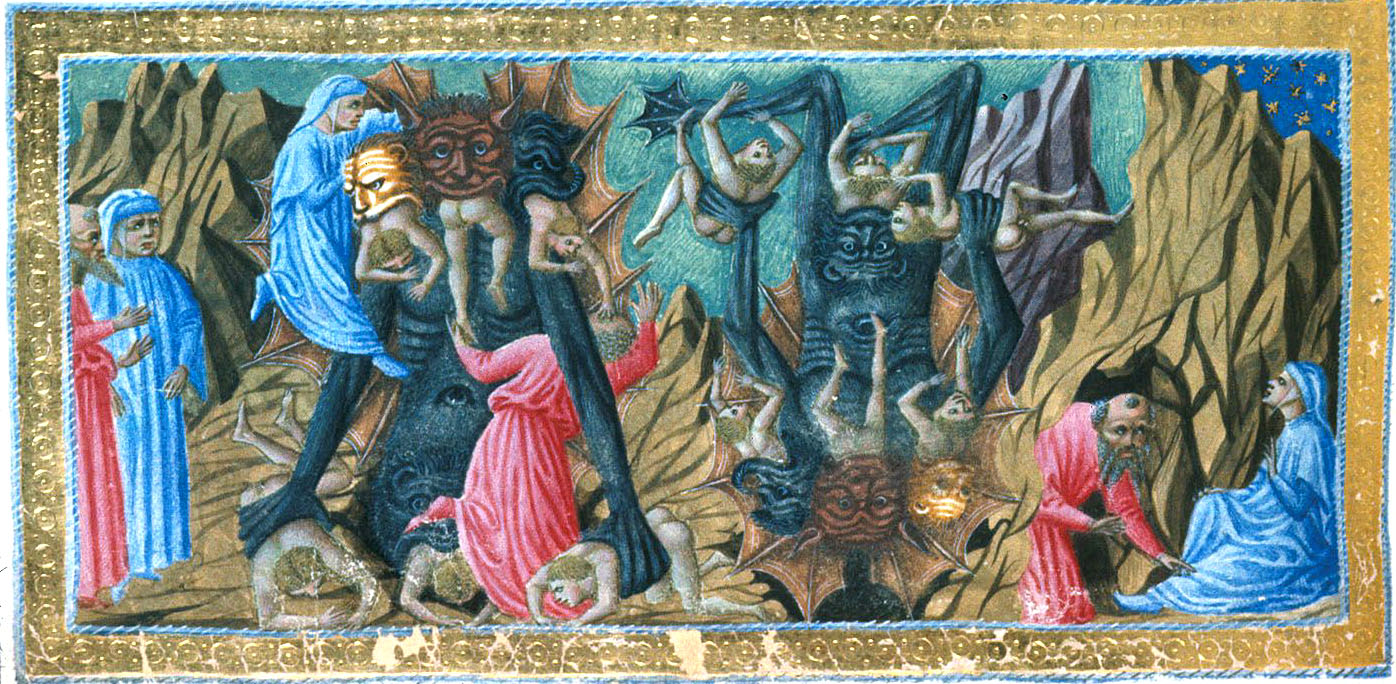
Esolen begins this chapter with the image of Satan from Dante's Inferno, trapped in ice, gnawing on three traitors. (This is from Inferno, Canto 34. The English text may be found here.) For Esolen, this is the image of modern, empty freedom: the licence to do everything become the emptiness of nothingness. (As an aside, it's worth thinking about Esolen's methodology here, in his constant reference to great works of art, visual and literary. Are these merely educational aids to make understanding of complex arguments easier? Or does art reveal something that the conceptual thinking of philosophy cannot? If a society has abandoned its great art, has it also abandoned a privileged access point to reality?)

An obvious objection here is that Satan (eg by being trapped in ice) is not at liberty at all. But the charge that liberty and democracy produces a sort of desperate and futile search for meaning and eventual tyranny is an old one. (The decline from democracy to tyranny is, for example, described by Plato in the Republic.)  The key thought here is that lack of an order based on human nature (and of the nature of the universe) leads to personal disorder (the triumph of tyrannical whims over reason) and social disorder (the triumph of a tyrant). 

Questions:

  • Isn't the promotion of maximum liberty the best form of government?
  • Given that we have no agreed idea of what a 'natural order' might be, isn't the best thing simply to allow people to do what they like?
  • We know that the past is shot through with patriarchy and other unfortunate tendencies. Doesn't this alone give as reason to prefer 'innovation'?

This is the end of the first week's work. Do feel free to keep commenting! The next post (week 2) will be on Monday 31 August.


--------------------------------------------------------------------------------
Works of Leo XIII referred to in chapter (in order of reference; page number in book cited):

Libertas praestantissimum here. (p.40) 

Praeclara grationis publicae here. (p.43)

Inscrutabili here. (p.43-4)

Quod Apostolici muneris  here. (p. 44)

Immortale Dei here. (p.44)

Humanum genus here. (p.44)

Rerum Novarum here. (p.44-5)

Inscrutabili here. (p.46)

Quod Apostolici muneris  here. (p. 46)

Immortale Dei here. (p.46)

Libertas praestantissimum here. (p.46)

Pervenuti all'anno (Italian version here.) (p.47) 

Immortale Dei here. (p.47)

Libertas praestantissimum here. (p.47)

Sapientiae Christianae here. (p.47)

Testem Benevolentiae here. (p. 48)


Tuesday, 25 August 2015

Reclaiming Catholic Social Teaching: Post 2


Previous post here.


Chapter I: Man, in the Image of God

We continue the first week's work of reading through the introduction and chapters I and II.

Key points:


  • A secular society which ignores God is a deeply flawed society because it misunderstands human beings and their nature.
  • Such a society becomes dominated by irrational and inconsistent desires.
  • Only in a Catholic society where unity is based on the unity of the Eucharist can human beings flourish fully.


My summary:

If we forget that human beings are made to enjoy God, any society based on such forgetfulness will be based on false principles and radically flawed. In particular, a society from which God has been banished will be subject to the 'domination of the passions' (p.26). Without Christianity -and in particular, without its source in the Eucharist- the bonds which link people to people in society will be lost.

My critical commentary:

 Esolen has in his sights here secularism. Although this is a term without any exact definition (and has been used in various ways in various contexts) one idea is that politics should be conducted without any religious content: that whatever we believe in private, as citizens we enter into a public space where public rationality excludes the introduction of views based on religious doctrine.

The problem with this is, as Esolen notes, if we believe that human beings are creatures whose happiness involves a relationship with God, any society that ignores such a relationship is not going to be well run. (It's rather as if, in constructing a society, we ignored the human need for food. It's just not going to turn out well...)

As well as this general point, Esolen argues for the specific importance of Catholicism. He takes The Angelus by Millet as an illustration of this.


[Image from Wikipedia. Details here.]

In essence, Esolen picks up from this painting a natural order (man/woman; labour/rest) in the context of the Church (the Angelus). Separate that natural order from Catholicism, and our understanding of it starts to fray.

What are we to make of this? Why should in principle truths be excluded from society simply because they are religious? (And what exactly is a religious truth as opposed to a common-or-garden one?) Certainly, if most people reject religion and especially Catholicism, then it's going to be difficult to persuade people in a democratic country to acknowledge beliefs restricted to those practices. But there are all sorts of truth that it might be difficult to persuade people of for all sorts of reasons...

On the other hand, isn't the truth of secularism that some things are quite obvious to all people (the human need for food and shelter) whilst some things are not (the human need for God)? Don't we have to compromise on what can be agreed, rather than what we might like to see agreed?

Esolen would undoubtedly reply here that, whatever the practical difficulties involved in convincing people of the truth about human beings, in the absence of such convictions, society will fare badly. Without at least the classical philosophical ideas of ordering our desires according to reason, society will be radically unstable as individuals pursue their whims.

Questions (please feel free to debate these or any others in the comments box below!):

  • Are you convinced by Esolen's vision of an ordered society? Why? Why not?
  • Philosophers such as Alasdair MacIntyre have argued that radical (and irresolvable) disagreement on values is part of the modern condition. If that is the case, are modern democratic states condemned to fail? 
  • Does Millet's The Angelus provide a helpful image of a society in good order?

I'll post on chapter 2 (the final one of this week) tomorrow (Wednesday)...


------------------------------------------------------------------------------------------

Writings of Leo XIII referred to in this chapter (in order of reference, page number in book given):

[No need to read these fully. Esolen usually provides extracts when discussing the texts. I have included these links to the full texts for those interested in pursuing further reading.]

Tametsi [1900] Here. (p15)

Rerum Novarum [1891] Here. (p.16)

Humanum Genus [1884] Here. (p.16)

Tametsi [1900] Here. (p17)

Aeterni Patris [1879] Here. (p.17)

Rerum Novarum [1891] Here. (p.18)

Au milieu des solicitudes [1892] Here. (pp. 21-3)

Humanum Genus [1884] Here. (p.23-6)

Affari Vos [1897] Here. (p.24)

Arcanum Divinae [1880] Here. (p.26)

Inscrutabili [1878] Here. (p.26)

Cum Multa Sint [1882] Here. (p.26)

Immortale Dei [1885] Here. (p.27)

Sapientiae Christianae [1890] Here. (p.27)

Tametsi [1900] Here. (p27)

Arcanum Divinae [1880] Here. (p.30)

Humanum Genus [1884] Here. (p.31)

Tametsi [1900] Here. (p.32)

Immortale Dei [1885] Here. (pp.32-33)

Mirae Caritatis [1902] Here. (pp. 33-34)

Pervenuti all' anno [1902] Italian version here. (p.34)

Libertas Praestantissimum [1888] Here (p.35)


[Image: Wikipedia details here.]

Monday, 24 August 2015

Reclaiming Catholic Social Teaching: Post 1


Welcome to the first post of this journey through Anthony Esolen's book, Reclaiming Catholic Social Teaching. If you want to see what I intend to be doing over the next four weeks, please see my previous post.

Week 1: (24 August 2015-30 August 2015)

During this week we'll be covering the introduction and chapters 1-2. (That's about 45 pages and for average reading speeds should take less than an hour.)

1) Introduction:

Key points:

  • We need to get first principles right: logical reasoning from flawed first principles produces erroneous conclusions.
  • We need to keep our eyes on 'human realities' (p.8). Even if our principles are wrong or unclear, keeping in touch with realities can stop us going too far wrong.
  • Catholic social teaching is not separate from other Catholic teachings: they form an integral whole.
  • Catholic teaching draws on natural reason as well as revelation. '[Leo XIII] heeds what the greatest thinkers, including the pagan philosophers of Greece and Rome, have to teach us. He draws upon that cast fund of human experience that is called history.' (p.11)


My summary:

Esolen concentrates on methodology in the introduction. He is going to take Leo XIII's writings as his focus for two main reasons. First, Leo XIII is frequently regarded as the founder of Catholic social teaching with his Encyclical, Rerum Novarum. (Encyclical is here. By all means read it if you wish! But there is no necessity to just now.) By exploring a wider range of his writings, Esolen intends to show that Leo does not intend a radical break with the past or with other (non-social) teachings: Catholic social teaching is simply an application to modern social conditions of traditional principles. Secondly, by examining a coherent presentation of those teachings, we will see that, instead of modern Catholic social teaching being identifiable as politically 'liberal' or even 'socialist', it is simply a development of the philosophical (and artistic) tradition of Western natural law thinking.

My critical commentary:

I think it's fair to characterise the 'Introduction' as an opening shot against the view that at some stage in modern times, Catholic social teaching became something separate from the other teaching of the Church, that it represents a break with the past, and that it is anti-capitalist and anti-tradition. Esolen doesn't directly tackle this point in the 'Introduction' but it's hard to resist the thought that at least some of his guns are trained against a 'hermeneutic of rupture': that Vatican II (and the social teaching that emerged afterwards) represents a break with previous teaching and an abandonment of a supernatural focus in favour of a 'this world' focus. Benedict XVI discussed precisely this point in his Christmas address of 2005:

It might be said that three circles of questions had formed which then, at the time of the Second Vatican Council, were expecting an answer. First of all, the relationship between faith and modern science had to be redefined. Furthermore, this did not only concern the natural sciences but also historical science for, in a certain school, the historical-critical method claimed to have the last word on the interpretation of the Bible and, demanding total exclusivity for its interpretation of Sacred Scripture, was opposed to important points in the interpretation elaborated by the faith of the Church.

Secondly, it was necessary to give a new definition to the relationship between the Church and the modern State that would make room impartially for citizens of various religions and ideologies, merely assuming responsibility for an orderly and tolerant coexistence among them and for the freedom to practise their own religion.

Thirdly, linked more generally to this was the problem of religious tolerance - a question that required a new definition of the relationship between the Christian faith and the world religions. In particular, before the recent crimes of the Nazi regime and, in general, with a retrospective look at a long and difficult history, it was necessary to evaluate and define in a new way the relationship between the Church and the faith of Israel.

These are all subjects of great importance - they were the great themes of the second part of the Council - on which it is impossible to reflect more broadly in this context. It is clear that in all these sectors, which all together form a single problem, some kind of discontinuity might emerge. Indeed, a discontinuity had been revealed but in which, after the various distinctions between concrete historical situations and their requirements had been made, the continuity of principles proved not to have been abandoned. It is easy to miss this fact at a first glance.


[Full address here. Again, there is no need to read this unless you want to.]

I suspect a not unfair summary of Esolen's aims would be along these lines: 'To resist the idea of a hermeneutic of rupture in Catholic social teaching, it's a good idea to go back to the root, Rerum Novarum. By examining that root in the full context of Leo XIII's thought, we'll see that there is no rupture, but simply a restatement of eternal principles in a (slightly) new context.'

Questions (please feel free to debate these or any others in the comments box below!):


  • How convincing do you find Esolen's approach? What's wrong/right with it?
  • Is my summary and critical commentary fair? 
  • Why look at the teachings of a nineteenth century pope? Wouldn't we be better starting somewhere more recent?
  • How much is the 'Introduction' coloured by American 'culture wars'? If it is at all, is that a bad thing? (On 'culture wars' you could read this. Again, there is no need to do this unless you wish.)

Additional material:

Here's an interview with Anthony Esolen on the book Reclaiming Catholic Social Teaching in which he introduces the key themes of the book. (There's some problem with the video until about 1 min in: start there.) It runs for about half an hour.


I'll post tomorrow on chapter one, 'Man in the image of God'...


Tuesday, 18 August 2015

New online course: Anthony Esolen on Catholic Social Teaching

Now that the school holidays are over (in Scotland at least!), I'm going to try something rather different for the Albertus.

From 24 August 2015 (ie next Monday) until 21 September 2015, I shall be running on this blog an informal course on Anthony Esolen's Reclaiming Catholic Social Teaching. For each of the four weeks of the course, I'll posting at least twice a week on the relevant portion of the book and responding to the comments box.  (There's no formal sign up procedure and no fees!) Even though the posts will be largely comprehensible without Esolen's book, I'd encourage you to buy it: it's available on Kindle as well as traditional formats.

I'll say something more about the overall thrust of the book once we've got started on 24 August. But its main interest for me is that it tries to show how Catholic social teaching, rather than being a relatively recent and discrete creation, is instead a natural outgrowth of the Church's traditional teachings on the relationship between God and human beings. It does this by focusing on the teachings of Leo XIII who, as the author of Rerum Novarum, is often taken to be the founder of modern Catholic social teaching.

As noted, Esolen makes extensive use of Leo XIII's own writings. I'll be placing links to those which can be found online here.

As a taster, here's a link to an article by Gerald Russello which gives some of the background to the book and the arguments it's stimulated.

See you on 24 August!

Tuesday, 30 June 2015

Are we all simply self-interested?


An interesting article here on changes in the understanding of economics from Dominic Burbidge in Public Discourse. (Those who attended our sessions in 2014/15 will note resonances with (eg) Odile Pilley's presentations.)

Anyone holding an economics degree has undergone the strange experience of sitting in a beginner’s class and being told to assume that we are all completely self-interested. I suffered this fate studying economics at Queen Mary, University of London, and then I suffered it all over again taking a class in formal modeling at the University of Oxford. If there is ever such a thing as brainwashing, this ritual is a good example.

Like many students, I questioned the assumption that man is simply homo economicus. Surely, I protested, people are sometimes capable of seeking the good of others. As any economics student will be able to tell you, the reply I got was not that I was wrong, exactly. Instead, I was told, “we just have to make this assumption before going further.” Teaching economics this way is like ushering students into Plato’s cave and then telling them that if they don’t assume the shadows on the wall are real, they will have nothing else to go by. Homo economicus is the only robust, repeatable model of human behavior, it is explained—the only consistent measuring tool for the social sciences and its best starting point.

Full article here.


[Image: Dives and Lazarus from the Master of the Codex Aureus Epternacensis, 1035-1040. Full details here.]

Friday, 19 June 2015

Laudato Si', the environment and natural law


I won't pretend to have digested (or even fully read) Pope Francis' Encyclical Laudato Si' yet. The full text is available here. As way of a stop gap (I'm sure we'll return to it again and again over the coming months!) here is some relevant material:

1) The Environment was one of the subjects tackled on our course in first term of 2015/16. The relevant blogposts on that session are here (which contains some helpful links to relevant supporting material) and here. The relevant handout from that session (containing among other things) extracts from previous teaching about the environment) can be found here (scroll down to find week 9).

2) The Compendium of the Social Doctrine of the Church deals with the environment in chapter 10: here.

My initial reaction is that this Encyclical is an extremely welcome addition to existing teaching in this area. It has always struck me as highly odd that, in a secularised culture which is highly responsive (at least in theory) to talk about the value and care of nature, this existing concern is almost completely divorced from valuing and caring about human nature: the very commodification of nature which is (rightly) condemned in environmentalism is instead celebrated in some of the 'neuralgic' issues of personal morality where the licence to create and recreate ourselves ignoring or even deliberately at odds with the rhythms of (human) nature is demanded as a right. Whether you emphasise the Hellenistic philosophical ideas of a right order in the kosmos and in the human being, or the scriptural account of a divine wisdom structuring all creation, this sort of divorce between human nature and nature tout court is profoundly foreign to Catholicism and, moreover, strikes me as an obvious tension in secularised thought which can be noted and engaged with. The Encyclical seems (at first sight admittedly) to make important progress here in articulating that Catholic sense of the naturalness of morality in the natural law.

My predecessor Benedict XVI likewise proposed “eliminating the structural causes of the dysfunctions of the world economy and correcting models of growth which have proved incapable of ensuring respect for the environment”. He observed that the world cannot be analyzed by isolating only one of its aspects, since “the book of nature is one and indivisible”, and includes the environment, life, sexuality, the family, social relations, and so forth. It follows that “the deterioration of nature is closely connected to the culture which shapes human coexistence”. Pope Benedict asked us to recognize that the natural environment has been gravely damaged by our irresponsible behaviour. The social environment has also suffered damage. Both are ultimately due to the same evil: the notion that there are no indisputable truths to guide our lives, and hence human freedom is limitless. We have forgotten that “man is not only a freedom which he creates for himself. Man does not create himself. He is spirit and will, but also nature”. With paternal concern, Benedict urged us to realize that creation is harmed “where we ourselves have the final word, where everything is simply our property and we use it for ourselves alone. The misuse of creation begins when we no longer recognize any higher instance than ourselves, when we see nothing else but ourselves”.

[Laudato Si', section 6: here.]